Showing posts with label Happy Learning. Show all posts

Wednesday, 13 May 2020

Surface Area Of A Cuboid

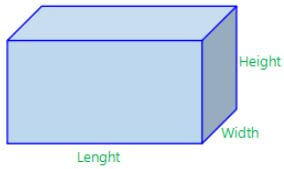
Dimension of a Cuboid
Cuboid

In this article, we'll learn what is Surface Area, Formula for surface area of a cuboid and how to apply it.

Surface area can be defined as the area of an outer part or the uppermost part of something. In case of a Cuboid, there are 6 rectangular surfaces, four walls, the top and the bottom surface. We label the dimensions of the cuboid with length(l), breadth (b) and the height(h).

Now the area of four walls is known as the Curved Surface Area or the Lateral surface Area of a Cuboid. The formula for Curved surface area of a cuboid is 2(l+b)h. Also the the area of four walls along with the top and bottom is known as Total surface area of a Cuboid. The formula to calculate the total surface area is 2(lb+bh+hl).

If you're wondering how these formulas have been derived, You can learn that with the below video.

Now, the area that we obtain for and geometrical shape is in square such square cm, sq. metres, sq. kms. Let's try to solve one problem based on surface area.

Example 1. The Dimensions of a cuboid are 10 cm length, 7 cm breadth and 5 cm height. Find the curved surface area and the total surface area of the cuboid.

Solution : L = 10 cm, b = 7 cm and h = 5cm

CSA of cuboid = 2(l+b)h = 2(10 + 7)5 = 2 * 17 * 5 = 170 cm²

TSA of cuboid = 2(lb + bh + hl) = 2[(10*7) + (7*5) + (5*10)] = 2[70 + 35 + 50] = 2 * 155 = 310 cm²

Example 2 : The Curved surface area of a cuboid is 96 cm². The length and breadth of the cuboid are 6 cm and 2 cm respectively. Find the height of the cuboid.

Solution: CSA = 96 cm² , l = 6 cm and b = 2 cm

CSA = 2(l + b)h -> 96 = 2(6 + 2)h -> 96 = 2*8*h -> 96 = 16h -> h = 96/16 -> h = 6 cm

Therefore, the height of the cuboid is 6 cm.

For more solved problems, you check out the below video:

If you want to learn the basic concepts of Arithmetic progression, Click on the link for the article.

I hope you like the article and learnt the concept of Surface area of Cuboid. Please share your feedback in the comments and don't forget to Subscribe Happy Learning for more videos.

Saturday, 9 May 2020

Basics Of Arithmetic Progression

Arithmetic Progression is one the most important and scoring
Topics in class tenth mathematics. In this article, we will learn the basic
concepts of arithmetic progression.

An Arithmetic progression can be defined as
a sequence of numbers in which the consecutive terms (beginning with the second
term) are formed by adding a constant quantity with the preceding term.
Examples of arithmetic expression are –

  1. Natural number – 1,2,3,4,5…. With 1 as first
    term as well as the constant quantity.
  2. 2,4,6,8,10…. It is an AP with 2 as first term as
    well as the constant quantity.
  3. 4,4,4,4,4,4…. It is an AP with 4 as first term
    and 0 as the constant quantity.
  4. A taxi charges Rs 16 for first km and Rs 10 each
    additional km. Fare would be 16, 26, 36….
  5. Price of a commodity is Rs 80. Each year its
    price decreases by Rs 10.

Resulting AP would be 80, 70, 60, 50… where
80 is the first term and -10 is the constant quantity.

Finite Arithmetic Progression can be defined as the
AP with finite number of terms. For example, AP – 2,4,6,8,10 has 5 terms.

Infinite Arithmetic Progression can be defined as the
AP with infinite number of terms. For example, AP – 3,6,9,12…. has infinite
number of terms.

First term of an Arithmetic Progression is denoted by
symbol ‘a’. Common Difference(constant quantity) is denoted by symbol
‘d’.

General form of AP is - a, a+d, a+2d, a+3d….

To determine the value of a term at a certain position in
the AP, we have the formula for nth term of an AP.

nth term of
AP
, an = a + (n-1) d

Sum of first n terms, Sn, can be determined by

                                             Sn
= n/2 [2a + (n-1) d]

Also, if the nth of the last term, l, is already known then
sum of first n terms would be

                                             Sn
n/2 [a + l]

Arithmetic mean is the quantity obtained by summing
two or more numbers or variables and then dividing by the number of numbers or
variables. For example, if a,b,c are in AP, then b = [a+c]/2 and b would be
called as arithmetic mean of a and c.https://youtu.be/qfA7RzrEkho

Sunday, 1 March 2020

Learn how to use cross multiplication method to solve pair of linear equations.

https://youtu.be/lsasku_3lDk

Learn how to use cross multiplication method to solve pair of linear equations.

Share and Subscribe.

#HappyLearning #education

Please hit the Like button